

Indoor TV antennas are still a sensible purchase, despite the advent of Wi-Fi enabled TVs and online streaming services. For anyone who wants to cord cut their cable TV subscription or if you’re looking to reliably access TV channels without a strong internet connection, an indoor TV antenna is just the thing to get free, over-the-air channels in your home. You won’t get Netflix, but it’s possible to tune in to big broadcasters like NBC, ABC, CBS and FOX without paying a penny.
But not all indoor TV antennas are created equal, and you’ll want to make sure that your specific model has the range to pick up signals from your closest TV tower. To help you find the right model, I put together a list of the best indoor TV antennas, with insight and advice from industry professionals and technology experts.
Selected.
How we picked the best Indoor TV antenna
When selecting our top picks, we drew on the advice of hardware and computing experts as well as our own experience as tech reporters and kept the below criteria in mind:
- Range: Off-the-shelf TV antennas can’t pick up signals thousands of miles away. It’s important to instead try and use models that cover TV towers in your vicinity, ideally under 50 miles away.
- Price: An indoor TV antenna is a good way to cut costs by getting rid of expensive cable TV subscriptions (or acting as an affordable supplement to existing subscriptions and services). So they shouldn’t cost an arm and a leg on their own. Our picks cost between $30 and $80.
The best Indoor TV antenna
The best indoor TV antennas come from a select few brands: namely Channel Master and Mohu. We list key specifications like range and dimensions under the “What to know” dropdown below each recommendation.
Expert-pick
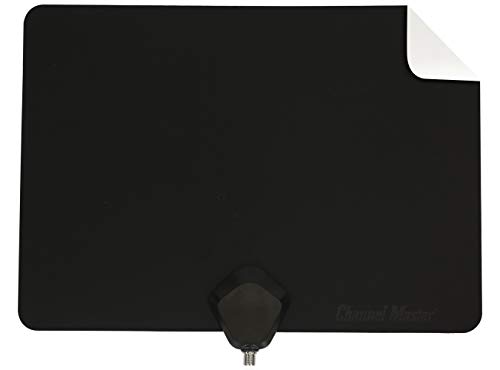
This HDTV antenna comes recommended by gadget expert and technology reporter Christian de Looper, who praised its “great range and slim design”. The Channel Master Flatenna is as flat as the name suggests and has a black or white side you can pick from to help it blend in more easily with your decor. This base model has a range of up to 35 miles, with a 12-foot coaxial cable, though you should keep it near a window to ensure it maintains a strong connection.
Best tabletop
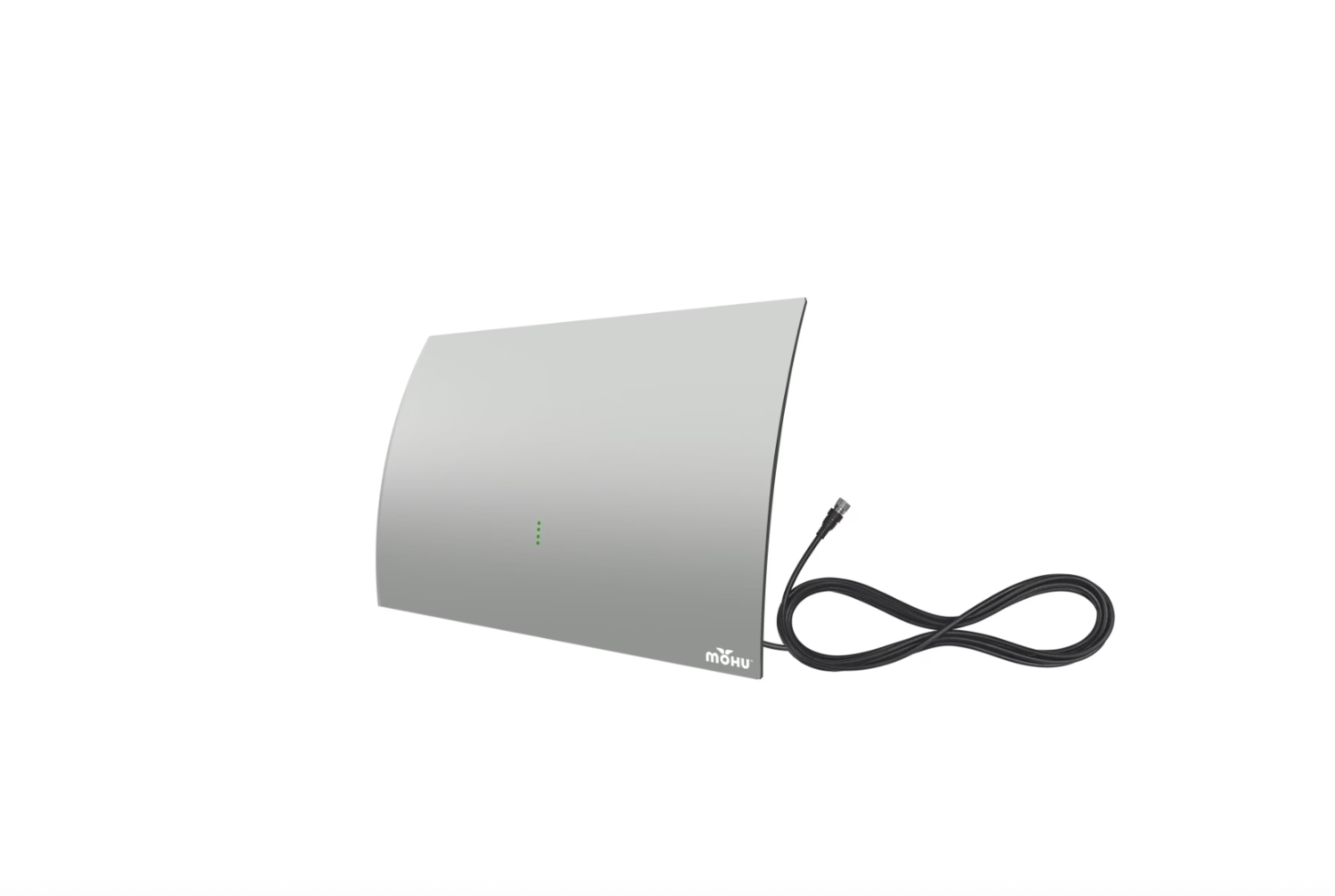
The Mohu Gateway is a better option for those who want something that can stand upright on a flat surface, says de Looper. Unlike our other picks, you don’t have to attach this antenna to a window or wall — it can sit on a table, countertop or windowsill easily. This amplified version can also reach up to a 60-mile range at the flip of a switch.
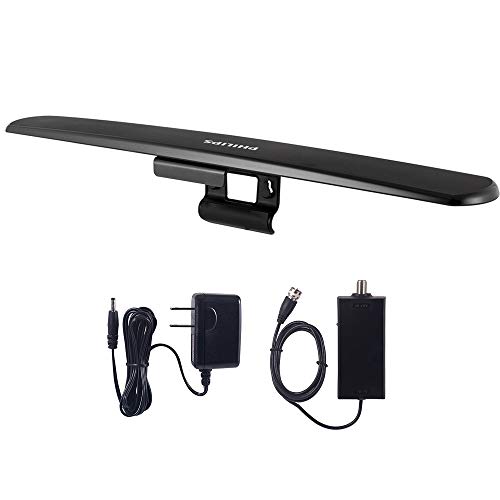
This antenna attaches to the top of your TV, meaning it won’t take up shelf, wall or window space. It has a 50 mile range, and connects to your TV through the included coaxial cable. It also has the most ratings of all our recommendations, with a 4-star average rating from over 10,000 reviews on Amazon.
This Mohu antenna is the thinnest and smallest on the list. It’s lightweight and flexible, and you can easily attach it to your window or wall with the included mounting kit. It has a far 60-mile range and a long 16-foot cable, the longest of all our picks. It’s also a bit more affordable than the Mohu Gateway Plus model.
How to shop for the best indoor TV antenna
Indoor TV antennas can be very similar to each other, but our experts say to keep the following in mind when shopping, no matter which brand you are considering:
Range is critical
The first thing to check is the range of your prospective TV antenna. Indoor TV antennas are usually capable of a 40- to 50-mile range, while outdoor antennas can reach as far as 80 or 90 miles, says Richard Schneider, the Founder and President of Antennas Direct. But you may not get the maximum range of your TV antenna, depending on your surroundings. If you live in a densely populated city with tall buildings and lots of radio frequencies around, you may get less range than advertised, says Schneider.
Plan your cable length
Consider the length of the cable the antenna comes with. You usually want to place an antenna near or on a window, but you may not have a window close to your TV, says Schneider. If that’s the case for you, consider purchasing an extension cable ahead of time.
Frequently asked questions
Do indoor TV antennas work well?
An indoor TV antenna works well depending on a few factors — including your distance to a nearby TV tower. If you’re within range, you can access a number of free TV channels. “American broadcasters have spent billions of dollars upgrading their infrastructure during the digital transition,” says Schneider. “Now you can get [a signal in] most cities, anywhere from 50 to 150 channels over the air; in minor markets, maybe it’ll be 25 to 40 channels.”
Another thing people are often “shocked to find out,” says Schneider, is that “the picture quality [of over-the-air broadcast signals] is generally better than that of satellite or cable, because there’s less compression and no degradation of the video signal.”
Does an indoor TV antenna have to be by a window?
Schneider tells us that over-the-air broadcast signals are “more or less line of sight”, meaning you’ll want a clear, direct line from the antenna to a TV tower. “TV antennas don’t penetrate terrain or obstacles very easily,” says Schneider.
If you are worried about having a big, unsightly antenna in your space, new, thin film antennas like the Mohu Leaf Plus are very unobtrusive.
What are the disadvantages of indoor antennas?
Indoor TV antennas are, by virtue of their placement indoors, more limited in range than outdoor models — and while they’re quite compact devices these days, it’s possible that they’ll take up more space than you’d like in a small home.
You’re also limited in the kind of content you can watch. Free, over-the-air broadcast channels cleave more toward news, sports and educational programming rather than the prestige TV dramas and massive content libraries of online streaming services.
Can a smart TV pick up local channels without an antenna?
No; smart TVs cannot pick up local channels without an antenna. Some smart TV platforms instead offer free live TV streaming, says de Looper. On Google TV, you can head to the Live section of the interface, while on Samsung TV, users can watch live TV through the Samsung TV Plus app. These channels aren’t local ones, so if you want access to your local news network, you’ll still need to get an antenna.
Meet our experts
At NBC Select, we work with experts who have specialized knowledge and authority based on relevant training and/or experience. We also take steps to ensure all expert advice and recommendations are made independently and without undisclosed financial conflicts of interest.
- Christian de Looper is a consumer technology reporter for Tom’s Guide, Digital Trends and TechRadar, with years of experience testing and reporting on household gadgets.
- Richard Schneider is the president and founder of Antennas Direct, an HDTV antenna business launched in 2003. (Schneider did not comment on individual products or make product recommendations for this guide.)
Why trust NBC Select?
Henry St. Leger has been a gadget reporter since 2017, covering the latest developments in consumer hardware, including smart TVs, soundbars and photo scanners. He also reports on games for GamesRadar, The Times and IGN.
Harry Rabinowitz is a tech reporter for NBC Select covering technology and fitness including stories on smartwatches, wireless earbuds and point-and-shoot cameras. He’s covered TVs and TV accessories for years, including guides to streaming devices.
Leger and Rabinowitz interviewed TV and TV antenna experts to better understand how they work and who should shop for them.
More tech essentials
- I tested the latest Oura Ring 4 for months — is it worth the upgrade?
- The best Oura Ring alternatives, tested by our editors
- The best smartwatches of 2025, tested by our editors
- I tested Apple AirTags for a week and yes, they are worth it.
- I’ve tested dozens of fitness trackers — here are the best ones for beginners, runners and more
Catch up on NBC Select’s in-depth coverage of tech and tools, wellness and more, and follow us on Facebook, Instagram, Twitter and TikTok to stay up to date.
