

Having a baby requires an almost comical amount of gear, from pregnancy pillows that support your belly to nourishing products for postpartum hair loss. But while some of those are nice-to-haves, the best maternity bras are essential if you plan to nurse your little one (or combo feed, meaning you supplement with formula).
I nursed my daughter for 15 months, and I couldn’t have done it without nursing bras, which made it possible to nurse her discreetly everywhere, including on flights and in (parked) cars. Unlike my typical bralettes and wireless bras, which are my usual preferences when I’m not nursing since I don’t need much support, these have clips or extra-stretchy straps that allow for easy access and comfortable latching. I drew from my own experience and talked to experts to find the best nursing bras out there.
 Best support$undefined$74.99


How I picked the best nursing bras
I put together this list of the best nursing bras by drawing from my own considerations when I was nursing (as well as what I learned during the process), as well as insight from professional bra fitters and lactation consultants. While there are a lot of options for nursing bras out there, what makes a style good for you can depend on your personal preferences and priorities. Based on what I learned, here’s what I took into consideration when putting together this list.
- Fabric: Soft, breathable fabrics that you can quickly throw into the wash (like nylon and cotton blends) tend to be more convenient and comfortable than lace or silk. It also helps if the fabric has some stretch, since breasts can change size during the postpartum phase.
- Accessibility: Since nursing bras are designed to offer easy (but discreet) access to your breast for nursing, they’re usually designed with clips or stretchy straps, which you can pull down. Either works, but it does help to have a design that you can manage with one hand.
- Adjustability: Since your bust size can fluctuate between late pregnancy, early postpartum and later postpartum, your bra should offer ways to adjust the strap and band sizes, or the option to add a cup if you need one.
Related

Want more from NBC Select? Sign up for our newsletter, The Selection, and shop smarter.
The best nursing bras in 2026

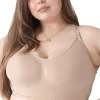
This wire-free bra has clips that you can detach (and reattach) single-handedly, an adjustable fit and removable cups. Plus, it’s versatile. “This gave me the soft support and easy clip-down access I needed, and it even worked with the wearable pump I tried,” says Becca Delman, NBC’s senior commerce photo editor. This is also the only bra I found that allows you to choose the band size and cup fit separately. However, she notes, while the fabric is thick and structured — which offered a lot of support — it could be too warm in hot weather.

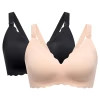
What sets this wireless, seamless bra apart is the “Jelly Strip” technology, which frames the cups to gently lift and support the bust without a wire. Delman found it so effective and genuinely comfortable “which is key postpartum,” she says. “It’s super breathable, and still secure — thanks to the one-handed clasp and padded design that made breastfeeding easy and comfy.” She says she even continued to wear it after her breastfeeding journey ended.

I went with these nursing bras on a lark, buying two when I was still pregnant (and had outgrown my usual A cups). There’s a lot to love about them: The removable cups gave me the option of more coverage, the clips were easy to snap on and off, and they stretched enough to fit my wearable pumps. And they had enough flexibility to accommodate my bust while pregnant, during engorgement, and once my supply (and therefore size) had stabilized. That said, the racerback design (which does offer support) means the straps peeked out of certain tops, and I didn’t always love having to pull the bra over my head when getting dressed.

This bra has four-way stretch and added knit around the cup to offer extra support, according to the brand, and comes with removable pads, adjustable straps and even a bra extender. “It’s soft, stretchy, and makes nursing easy with clips that let me unfasten it quickly when I need to,” says Delman, who’s been wearing it since her son was born. “It’s honestly just really comfortable.”

A maternity sports bra might be a niche offer, but I picked this up when I was pregnant, since I run a few times a week. Instead of clips, it has a stretch built into the straps that allow you to pull the cups to the side for nursing. That made it easy for me to squeeze in a quick run between nursing sessions early in the postpartum phase (when babies eat more frequently), or after a yoga class if I met my husband and daughter for brunch afterwards. The cups are moldable and comfortable, and I’ve regularly used it in between having my first and now during pregnancy with my second.

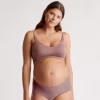
I didn’t buy this bra with nursing in mind, but found it really nice for my overnight nursing sessions. It has enough stretch to pull down, and the soft, comfortable band made it feel virtually undetectable while I was asleep — it’s as close to not wearing a bra as I’ve ever gotten. The shoulder straps are adjustable, too, although they’re a bit thin. However, it’s worth noting that I started with a small bust and only went to a B cup when I was nursing, so this might not offer much support if you have a larger bust.
Related

How to shop for a nursing bra
When you’re shopping for a nursing bra, the biggest thing is that there’s no one “perfect” nursing bra for everyone, according to Kimmay Caldwell, a bra fitting expert, trainer and founder of Fitters’ Formula. Rather, it’s about finding a mix of support, flexibility and ease. “This is the time of your life when your bust will be at its heaviest and most sensitive, so a great fit with good support is so important,” she says. “Some folks prefer molded or padded cups for coverage, while others love the simplicity of a stretchy wire-free bra.”
Ultimately, you just want to look for features that line up with your lifestyle and comfort preferences. The biggest things to consider are:
- Accessibility: The whole point of nursing bras is to make it easy to nurse — versus trying to shimmy a cup or strap off every time you want to breastfeed. Many styles therefore include clips, but it helps to look either for clips that can be unclipped with one hand (since you might be holding your baby in the other) or a pull-down design without a clip. It should feel intuitive to you.
- Fabric: Natural fibers, like cotton, that are breathable and easy to clean, according to lactation consultant Leigh Anne O’Connor, IBCLC; nylon, a synthetic fabric, is also popular since it’s easy to wash and holds up to frequent wear. It gets bonus points if it feels soft and has some stretch, which is why a lot of options on our list have either Spandex or elastane. A soft material “can feel best against extra-sensitive skin — a common issue during this time — while stretchy fabrics are especially helpful in those first few weeks of fluctuating sizes,” says Caldwell.
- Adjustable fit: Your bra size can change drastically between your third trimester, early postpartum and later postpartum; that’s because engorgement (in which milk builds up, causing the breasts to expand) usually occurs right after you give birth. Your size can even change depending on whether you’ve just fed your baby or not. For that reason, our experts recommend designs that allow you to adjust the shoulder straps and bands. These “can assure the bra fits your bust and body specifically, which always feels better,” says Caldwell.
- Straps: Cute, lacy straps should wait until you’re done nursing, since your breasts naturally get bigger (and heavier) when you’re nursing. Instead, “wide straps or supportive bands help distribute weight without digging in,” says lactation consultant Tiffany Carter Skillings, IBCLC. Plus, a supportive band can be helpful in keeping your chest lifted if you don’t want to wear an underwire.
What to avoid when choosing a nursing bra?
For most people, it’s a good idea to avoid underwire bras, which can be tight and rigid — not to mention could potentially impact your breast health. “Restrictive bras can contribute to clogged ducts or mastitis, and no one needs that on top of postpartum life with a newborn,” says Skillings. (Mastitis is inflammation of the breast tissue that’s sometimes caused by an infection.)
If you do choose a bra with underwire — which is, to be fair, the most supportive option for large breasts, just make sure the fit can accommodate your postpartum body. “The wire should encompass all of the breast tissue and sit on the rib cage under the arm,” says Margo Hall, a professional bra fitter and owner of The Bra Spa.
On the other hand, it’s also worth avoiding extra-stretchy styles that aren’t adjustable, “especially if you have a smaller band and fuller bust or a very heavy bust,” says Caldwell. While they can be comfortable for sleeping, they don’t offer much lift or support.
And finally, skip the lingerie. These can be unsupportive and take more time to wash (think: hand wash and air dry), says Caldwell, which is just not very convenient when you have limited time to do laundry.
When should you buy a nursing bra?
First, don’t wait until you’re holding your baby to buy a nursing bra. Instead, our experts recommend shopping when you’re around 30 weeks pregnant. “By then, your size has usually stabilized,” says Caldwell. However, you should plan for engorgement and go up a size for a few bras. “Your bust will get much larger once the milk supply comes in, so a stretchy, wire-free style can carry you through those first postpartum weeks of engorgement and size changes,” she says.
Once your milk supply levels out (since it’s determined by how much your baby eats), you can see if the bras you got at 30 weeks fit. If not, try to get a professional fitting once you’re ready to venture out, says Hall. Breast sizes can fluctuate so much during this time that an expert can help you take the guesswork out of it.
Should my nursing bra be tight or loose?
It should feel supportive, but never restrictive. The band should be “snug like a hug” directly underneath the bust, according to Caldwell. “Most people wear bands way too loose, looking for comfort,” she says. “But that just causes the band to ride up, the cups to fall down and dig into the front of the body, and puts all of the pressure on the tops of the shoulders.”
You’ll be able to notice once you wear it. “If a bra leaves marks on your skin or feels compressive, it’s probably too snug,” says Skillings.
However, if you’re wearing a nursing bra to sleep or are just spending a lot of downtime at home with your baby, the style could be more flexible and slightly loose. “That way it will give you flexibility as you lay down,” says Caldwell. “For anyone going out and about or working, up the level of support.”
How to pick the right size nursing bra
Ideally, you would go to a bra store when you’re a few weeks out after giving birth and get a professional fitter, our experts say — but that might not be realistic with a newborn. In that case, find a soft tape measure and grab a pen and paper to take measurements. This is what Caldwell recommends:
- Measure around your ribcage (just under the breast). Go to the nearest even number, rounding up if you have an odd number. This is your band size.
- Then, measure around the fullest part of your bust for the cup.
- Finally, for your cup size, subtract the band size from the bust measurement and assign 1 cup size up the alphabet for every inch difference. For example, 7 inches difference is a G cup (the seventh letter in the alphabet).
You can always do this ahead of time (again, at the 30-week mark) to guesstimate your size. “I typically suggest to plan up about one to two cup sizes for engorgement — either a cup that is actually one to two cup sizes larger or something that can stretch up one to two cup sizes,” says Caldwell. When in doubt, she says, choose a wire-free style with slight stretch, which is more forgiving during the early weeks of fluctuation.
Frequently asked questions
Not necessarily, since milk supply is all about milk removal, says Skillings. “But a poorly fitting bra that causes feedback to the breast cells that decrease supply and lead to clogged, inflamed ducts could indirectly affect supply, so the fit does matter,” she says.
It ultimately depends on how much laundry you want to do. At a minimum, go with four — “one to wear during the day, one to wear at night, one in the laundry and one on stand by,” says Hall. And consider that you may need to adjust sizes as your baby grows. “As the baby weans and the breasts are less full, a new size may be necessary,” she says. I had three dedicated nursing bras, a soft bralette for sleeping, and a nursing sports bra, and thought that that was fine.
It’s up to you. If you feel more comfortable or secure with one on, “I recommend having a very loose bra with no underwires,” says O’Connor. One advantage is that they can hold nursing pads overnight (since you might leak in between nursing sessions). I slept with a bralette with nursing pads for a few weeks until finding pads that adhered to my tank top — at which point I skipped the bra.
Meet our experts
At NBC Select, we work with experts who have specialized knowledge and authority based on relevant training and/or experience. We also take steps to ensure all expert advice and recommendations are made independently and without undisclosed financial conflicts of interest.
- Kimmay Caldwell is a bra fitting expert, trainer and founder of Fitters’ Formula.
- Margo Hall is a bra fitting expert and the founder of The Bra Spa, a bra boutique in Tucson, Arizona.
- Leigh Anne O’Connor, IBCLC, is a lactation consultant with more than 20 years of experience based in New York, New york. She has served on the Board of the New York Lactation Consultant Association.
- Tiffany Carter Skillings, IBCLC, is a lactation consultant and midwife with more than 10 years of experience based in Yarmouth, Maine. She’s a member of the United States Lactation Consultants Association.
Why trust NBC Select?
Deanna Pai is a freelance beauty and wellness writer and editor who has been covering beauty and health for more than a decade, including topics like postpartum hair loss and pregnancy pillows. She spoke to two lactation consultants, two professional bra fitters, and other NBC Select staffers who nursed their babies to determine the best nursing bras.
Catch up on NBC Select’s in-depth coverage of tech and tools, wellness and more, and follow us on Facebook, Instagram, Twitter and TikTok to stay up to date.



