
Welcome to From the Politics Desk, a daily newsletter that brings you the NBC News Politics team’s latest reporting and analysis from the White House, Capitol Hill and the campaign trail.
In today’s edition, we dig into yet another visit to Texas from the president. Plus, Andrea Mitchell examines what has — and hasn’t — happened since Hamas’ Oct. 7, 2023, attack on Israel.
— Adam Wollner
Trump’s Texas two-step
By Adam Wollner
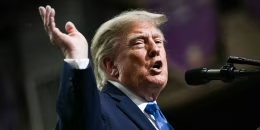
President Donald Trump is making his second trip in the past week to Texas tonight, highlighting how the midterm fight has shifted traditionally red terrain in the final stretch.

 FOR SUBSCRIBERS‘Still in this very long day that started on Oct. 7th’











FOR SUBSCRIBERSThis voting bloc holds the key to the midterms


He’s set to rally in San Antonio for state Attorney General Ken Paxton and congressional candidate Carlos De La Cruz. Paxton remains locked in a tight and expensive battle with Democrat James Talarico. And De La Cruz’s race in the 35th District, which was redrawn in the redistricting process last year to be more favorable to Republicans, has been more competitive than expected. While Trump would have carried the district under its new lines by 10 points in 2024, the Cook Political Report with Amy Walter rates the race as “lean Republican.”
Notably absent from tonight’s rally? Gov. Greg Abbott, who cited a scheduling conflict.“Well, first, whenever he does show up, it leads to excitement among the base, and he does a good job of getting the base organized and turning out,” Abbott said yesterday of Trump.
“Because of the schedule that I run, where I go to multiple cities a day doing events like this, already have events like this scheduled that day, and I will not be able to make it,” he added.
Abbott is also facing a tougher re-election battle than Republicans anticipated at the outset of the cycle: He won his last three races for governor by double digits.
But the broader political environment has proven treacherous for Republican candidates across the board. And now, national Democrats are under growing pressure to spend more resources on behalf of gubernatorial nominee Gina Hinojosa, who is at a major financial disadvantage against Abbott.
Natasha Korecki reports that Latino leaders in Texas, including members of Congress, met with the Democratic Governors Association this morning to discuss Hinojosa’s campaign. In a letter, a group of Latino stakeholders in the state called on the DGA to “make a real meaningful investment of $3 million” into the race before early voting begins in less than two weeks.
The DGA recently committed $1 million to the race, while Illinois Gov. JB Pritzker announced he would send $1 million to her campaign after already giving $200,000. (The New York Times first reported on those contributions.)
Meanwhile, Abbott isn’t the only Republican on the ballot this fall who appears to be seeking some distance from Trump. Michigan GOP Senate nominee Mike Rogers said in a new ad today that “we need to end this tariff war now.” The party’s candidate for governor in the state, John James, also put daylight between himself and Trump on tariffs and the Iran war at a debate last night.
🥊 More from the debate stage: In the Maine Senate race, Republican Sen. Susan Collins and Democrat Troy Jackson traded attacks over Trump, the cost of living and abortion. In Georgia’s race for governor, Democrat Keisha Lance Bottoms and Republican Rick Jackson also sparred over Trump and the economy. And in the Iowa gubernatorial contest, Republican Zach Lahn’s residency history was a major topic.
The Oct. 7 attack, three years later
Analysis by Andrea Mitchell
At dawn on a holiday weekend three years ago today, Israel was stunned when hordes of Hamas terrorists stormed across its border, slashing and and kidnapping revelers at an all-night music festival and rampaging through nearby settlements, or kibbutzim. In total, 1,200 Israelis and foreign nationals, including 46 U.S. citizens, were killed, while 251 were taken hostage.
FOR SUBSCRIBERS‘Still in this very long day that started on Oct. 7th’
FOR SUBSCRIBERSThis voting bloc holds the key to the midterms
Thus began a war that shattered Israel’s confidence in its military superiority and ultimately transformed the region, sowing the seeds for the current war against Iran. Despite a ceasefire and hostage release, the conflict in the Gaza Strip and now the occupied West Bank continues at a slow burn with periodic outbreaks to this day.
How could Israel have been so taken by surprise? Although Israeli Prime Minister Benjamin Netanyahu has blocked an official investigation into how his country’s vaunted military could have been so blindsided, NBC News has confirmed authoritative reports on the colossal intelligence failure, including a stunning account that an all-woman border patrol’s early warnings were dismissed by male superiors. Inexplicably, it took more than six hours after the massacre for the country to mobilize a response.
The human cost is incalculable. By the numbers, the Hamas-led Gaza Health Ministry estimates that about 75,000 people, including more than 44,000 children, have died in Gaza. Thousands more have been injured. Israel says it has lost 970 soldiers. Gaza has largely been leveled, its housing, schools and hospitals destroyed. The International Criminal Court, a United Nations entity that is not recognized by either Israel or the Trump administration, has cited both sides over allegations of war crimes. And the conflict has fueled cries of genocide against Israel by protesters in Europe and the U.S., an accusation that’s offensive to those in a country born as a refuge for survivors of the Holocaust.
Based on a Biden administration plan, Trump’s envoy Steve Witkoff and son-in-law Jared Kushner finalized a ceasefire and release of surviving hostages, as well as the return of hostage remains. The White House promises that its Board of Peace — a group of world leaders each pledging $1 billion to a nongovernment entity led by President Donald Trump — is supposed to be recruiting a multinational peace-keeping force to disarm Hamas and get Israel to withdraw to a border buffer zone. Trump has said the Gaza Strip could be rebuilt as “The Riviera of the Middle East.” None of that has taken place.
Now, Netanyahu faces a closely fought election in three weeks that has become a referendum on his conduct of the war in Gaza and failure to prevent it. His national security ministers are spearheading a campaign to seize as many Palestinian villages in the disputed West Bank as possible now as a hedge against a victory by a government less opposed to a Palestinian state. And Israel’s conduct of the war has become a political issue in the U.S. that could affect some of this year’s key midterm races as well as the Democratic Party’s nominating contest in 2028.
Fiona Glisson contributed research.
🗞️ Today's other top stories
- ☀️ Sunshine State survey: Republican Byron Donalds holds a 7-point advantage over Democrat David Jolly in the Florida governor’s race, according to a new NBC South Florida/Telemundo Station Group poll, while GOP Sen. Ashley Moody is up by 10 points in her matchup against Democrat Angie Nixon. Read more →
- 🔵 2028 watch: Sen. Ruben Gallego, D-Ariz., rolled out a national economic plan that calls for boosting the minimum wage to $20 per hour and a New Deal-style public service jobs program funded by taxes on artificial intelligence companies and data centers. Read more →
- 🗣️ Consultant corner: Trump suggested he could fire two of his top political advisers following a New York Times report that they did election consulting work in the Balkans in recent days. Read more →
- ☑️ Fact check: Trump keeps touting that $21 trillion has come into the U.S. as a result of his economic agenda, but experts say those numbers are far from reality. Read more →
That’s all From the Politics Desk for now. Today’s newsletter was compiled by Adam Wollner.
If you have feedback — likes or dislikes — email us at politicsnewsletter@nbcuni.com
And if you’re a fan, please share with everyone and anyone. They can sign up here.
