
Sara Elsherbiny was preparing to celebrate her birthday by breaking her Ramadan fast with friends at a restaurant in Dubai.
Instead, as the sun set Feb. 28, explosions echoed nearby, rattling her home and shaking the city.
“It was loud, actually the house shook, and that was the first time that we’ve experienced something like that,” Elsherbiny told NBC News.
In a different part of the city, Ali and his wife were also breaking fast on the same day — the 11th day of Ramadan. He recalled watching missiles streak across the sky.
“We broke our fast normally but the Ramadan vibes were no longer there,” he said. “We were worried about further escalations.”
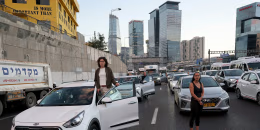
Hours earlier, the United States and Israel had launched strikes on Iran, prompting retaliatory Iranian attacks across the region.
Follow along for live coverage.
With Ramadan coming to an end and Eid al-Fitr starting, what is typically a time of celebration and communal prayer has been upended across the Middle East, as ongoing strikes reshape one of the holiest periods for Muslims. The region’s residents, some of whom declined to use their full names or spoke to NBC News on the condition of anonymity for safety reasons — described their most surreal and frightening moments of the past month.


Across the region, Muslims say the rhythms of daily life during the holy month — from communal iftar meals to late-night gatherings and Eid preparations — have been disrupted by air raid alerts, displacement and the threat of aerial attacks.
Too close to home









For some, the war has collided with deeply personal moments.
A Dubai-based media professional, who did not want to be identified, said she went into labor Feb. 28 as explosions sounded across the city.
“We didn’t know what to do, shall we go to the hospital or call an ambulance?” she said.
She and her husband ultimately drove to a nearby hospital, where doctors assured her she was safe. But as she was being prepared for an epidural, phones in the room blared an alert warning people to stay indoors and away from windows due to a missile threat.
“My body was shaking,” she said.
Others have come face to face with the terror of war.
Samah, an entrepreneur who runs an entertainment business out of a Dubai warehouse, said an explosion hit about 1.2 miles away while she was at work.
“I never imagined that one day, I would hear these kinds of sounds and feel that my life, my family, my cats and the country I have called home since I was young could be threatened,” she said. “It really feels like a nightmare.”
Samah said she later learned that debris from the explosion hit a car, killing its driver.
“I kept thinking that I was only a short distance away from death, yet somehow I survived and was given another day to live,” she said. “That thought stayed with me and made the whole experience feel even more real and heavy.”
A region on edge
Since the start of the war, more than 2,000 people have been killed across the Middle East. In Iran, Israeli and American strikes have killed more than 1,200 people, according to the Iranian Red Crescent Society. At least 1,000 people have been killed in Lebanon, and eight have been killed in the United Arab Emirates, according to local officials. Retaliatory strikes killed 15 civilians and two military personnel in Israel. Thirteen U.S. service members were killed in combat, while three died of noncombat causes.

In Minab, in southern Iran, an elementary school was struck on the first day of the war, killing more than 160 people, most of them children, according to the town’s mayor.
U.S. officials told NBC News that preliminary findings reveal that American munition was probably responsible for the strike. Amnesty International and Human Rights Watch have urged the U.S. and Israel to investigate the attack as a war crime to hold those responsible accountable.
Hamid Bendaas, a communications professional based in Washington, D.C., said he has struggled to reach family members in central Iran because of the country’s communications blackout.
“My hope is that it ends as soon as possible and ends immediately, because I think that is possible,” the 32-year-old said. “I think it’s very clear at this point that most people don’t want this war to continue.”

As an Iranian-American, he said, hearing about the casualties on both sides has been especially difficult but the war has underscored one of Ramadan’s central messages: caring for others, especially the less fortunate,
“I think I just want people to understand that people in Iran are very much like them,” Bendaas said. “They didn’t do anything to deserve what they’re facing right now, and they’re being collectively punished for something outside their control.”
Displacement and loss
In Lebanon, about 1 million people have been displaced since the start of the war, according to local officials, many for the second time in two years. The majority of the displaced come from Lebanon’s south, which is predominantly Muslim.
Basma Alloush, a deputy director for communications for the International Rescue Committee, said she recently met a 2-year-old named Sara who was born in a shelter in 2024 and is now living in one again.

“For many kids, this is the life they’ve known,” Alloush said. “Their schooling has been disrupted, their daily life has been disrupted and they don’t know what life outside of violence looks like.”
Families living in shelters in Beirut tell Alloush that Ramadan has been especially difficult. Many relied on donated meals for iftar, she said, but families tell her “it’s not the same.”
“They don’t get to choose what they’re eating, they don’t get to make their favorite dishes or cook the way that they used to,” Alloush said.
Faith amid fear
For many across the region, the sense of community that defines Ramadan and Eid al-Fitr has been shattered.
With the war ongoing, gatherings have been scaled back or canceled, and even routine outings feel risky.
Samah said she no longer feels comfortable making the hourlong drive to break her fast with her family.
“Even if you do go out, there is no guarantee that anywhere is truly safe, not even your own home,” she said.
The excitement of Ramadan and Eid have all but evaporated for Ali. In past years, he said, he marked the occasion by attending iftars at Ramadan tents and gathering with friends. But like everyone who spoke to NBC News, faith has become more central this year. Ali said the concept of “tawakkul” — placing trust in God — has helped him cope with the uncertainty.
Plans for Eid al-Fitr, which usually include large gatherings and celebrations marking the end of the fast, have also been scrapped for many.
“It’s hard to feel the joy and celebration when you are living with uncertainty and risk, not knowing when this situation will end,” Samah said. She emphasized, however, that “faith gives us strength during difficult times.”
In Lebanon, displaced families told Alloush that Eid will not feel the same in shelters. One 11-year-old, Zainab, said she wishes to celebrate Eid in her home in the south.
“She doesn’t know if her home is still standing or not, she doesn’t know when she’ll leave the shelter but her immediate wish as an 11-year-old was just to spend Eid at home with her family,” Alloush said.

