
TOKYO — Japanese Prime Minister Sanae Takaichi warned of growing Chinese “coercion” in her first post-election speech to parliament on Friday, pledging to overhaul defense strategy, ease curbs on military exports and strengthen critical supply chains.
Takaichi’s four-month tenure has been marked by a diplomatic dispute with China after she said Japan could use military force to respond to any attack on Taiwan that also threatened Japanese territory.
Fresh from turning a fragile majority into a landslide victory in this month’s lower house election, Takaichi outlined an agenda to counter what she sees as a mounting economic and security threat from China and its regional partners.
With her governing coalition now holding more than two-thirds of seats, she faces little political resistance.
“Japan faces its most severe and complex security environment since World War II,” Takaichi said, pointing to China’s widening military activity and closer security ties with Russia, as well as North Korea’s growing nuclear missile capability.
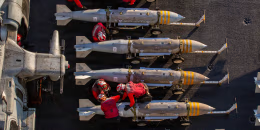
She said the government would revise Japan’s three core security documents this year to produce a new defense strategy and would accelerate a review of military export rules to expand overseas sales and strengthen defense companies.

A policy panel of Takaichi’s Liberal Democratic Party proposed on Friday to scrap rules that limit military exports to non-lethal equipment such as body armor, the Kyodo news agency said.
Such a change could significantly widen the range of defense equipment Japanese firms can sell overseas.
“China has intensified its attempts to unilaterally change the status quo through force or coercion in the East China Sea and South China Sea,” she told lawmakers.
Takaichi has hastened a military build-up launched in 2023 that will double Japan’s defense spending to 2% of GDP by the end of March, making it one of the world’s biggest military spenders despite its pacifist constitution.












She also announced plans for a national intelligence council chaired by her to consolidate information gathered across agencies, including police and the defense ministry.
Japan does not have foreign or domestic intelligence services comparable to the U.S. Central Intelligence Agency (CIA) or Britain’s MI5.
Beyond security, Takaichi proposed setting up a Japanese version of the U.S. Committee on Foreign Investment (CFIUS) to screen overseas investment in sensitive sectors, and said rules governing land purchases by foreigners would be reviewed.
She pledged to reduce dependence on “specific countries” by strengthening supply chains and working with allies to secure critical materials, including rare earths, around Minamitori, a remote Pacific island.
Takaichi also promised to speed the restart of reactors idled since the Fukushima nuclear plant disaster in 2011.
“A nation that does not take on challenges has no future,” she said in concluding remarks. “Politics that only seeks to protect cannot inspire hope.”

