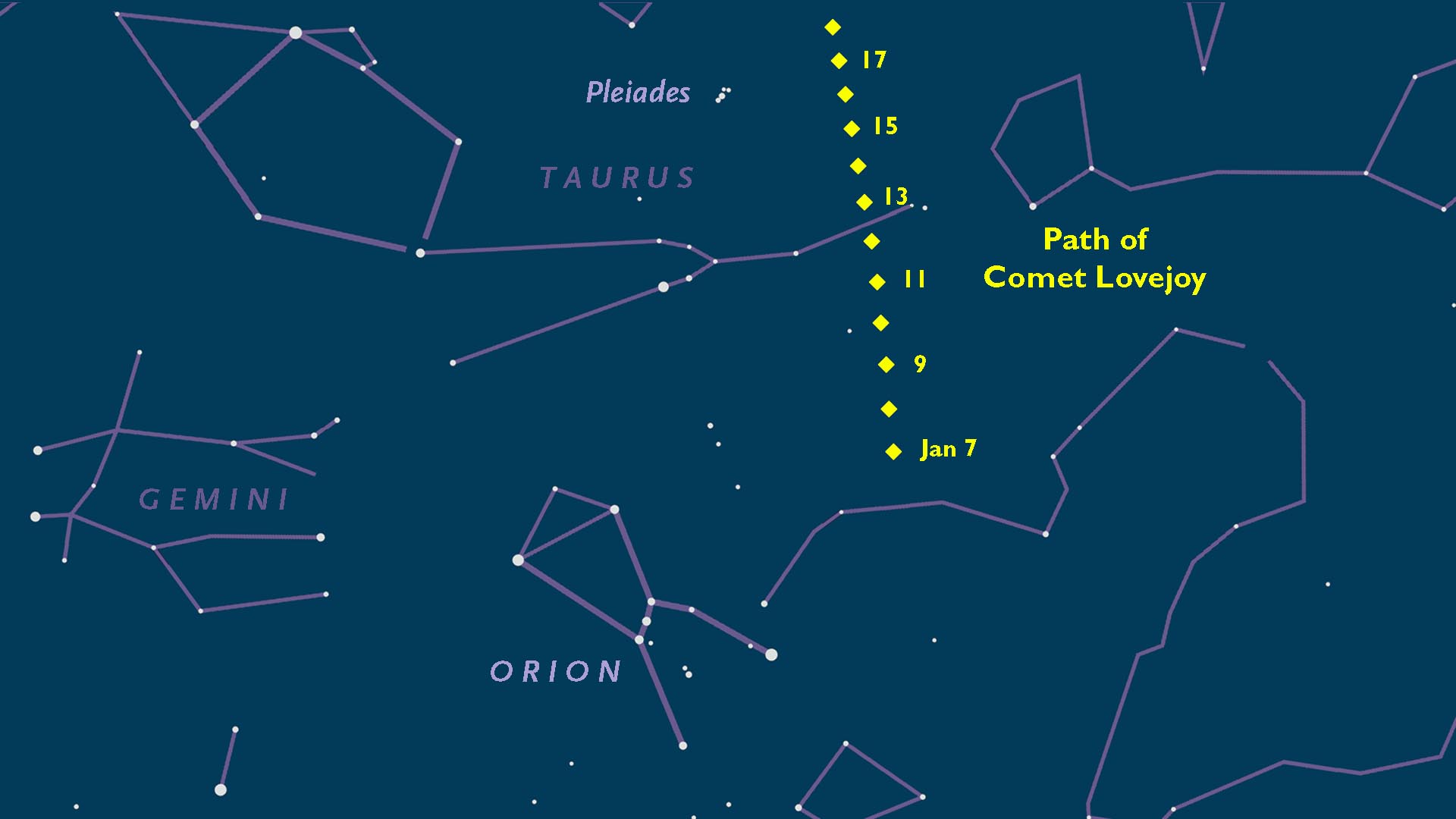
It's prime time for Comet Lovejoy (C/2014 Q2), this month's "It" comet: Wednesday night marks the comet's closest approach to Earth, at a distance of 44 million miles (70 million kilometers), and heralds the start of the best season for viewing. But you have to know where to look.
"If you can find Orion shining high in the southeast after dinnertime, you'll be looking in the right direction to track down Comet Lovejoy," Sky & Telescope senior editor Kelly Beatty said in a news release. Sky & Telescope's finder charts should help you spot the comet during the next couple of weeks, when it's theoretically bright enough to be seen with the naked eye.
"Theoretically" is the operative word, because you'll have a better chance of seeing the fuzzball if you're equipped with binoculars or a telescope.
Photographs reveal a greenish glow to the comet's coma, due to the presence of diatomic carbon and cyanogen. There's a faint tail as well, but you're unlikely to see that kind of detail with the naked eye.
The comet was discovered last August by Australian amateur astronomer Terry Lovejoy, who has discovered four earlier comets (some of which also came to the public's attention as "Comet Lovejoy.") For days, skywatchers have been posting pictures to Facebook pages and SpaceWeather.com's comet gallery. AmazingSky.com's Alan Dyer ranks among the most vigilant comet-watchers.
For more about the prime-time comet, check out the updated viewing guides from Space.com, EarthSky.org and Sky & Telescope. Virtual Telescope Project 2.0 is planning an online viewing party at 2 p.m. ET Jan. 11.
If you're hunting for Comet Lovejoy on Wednesday night, take a look at Jupiter and the moon as well. They should be rising over the eastern horizon around 8 p.m. local time. "As the evening wears on, both the moon and Jupiter will appear to ascend in the sky, side by side," Space.com's Joe Rao writes.