
At least 18 people have been killed in clashes between police and demonstrators during violent nationwide protests against President Bingu wa Mutharika, the Malawian health ministry said Thursday.
Spokesman Henry Chimbali confirmed 10 deaths in the northern cities of Karonga and Mzuzu, where protesters angry at chronic fuel shortages and Mutharika's perceived autocracy ransacked the offices of his Democratic Progressive Party (DPP) on Wednesday.
The others died in the capital, Lilongwe, and the southern commercial hub of Blantyre after police and troops fired teargas to disperse crowds demanding Mutharika quit as leader of the impoverished nation of 13 million.
"These figures are based on those casualties that are coming through to the hospitals. Some died in hospital while some were brought by police already dead," Chimbali told Reuters. A further 41 people were injured, six critically, he added.
The bloody crackdown in the normally peaceful former British colony is likely to intensify public anger against Mutharika, a former World Bank economist first elected in 2004, and could destroy his already troubled relationship with the donors who keep his government afloat.
As riot police confronted groups of youths in the capital, Mutharika took to the airwaves to appeal for calm, saying he was happy to hear the grievances of opponents who accuse him of ignoring civil liberties and ruining the economy.
"Stop the rioting and let's sit down to discuss," he said in a 12-minute address on state radio that also hinted at a fiercer crackdown. "I have a responsibility, based on the powers vested in me by the constitution, to bring law and order."
The unrest is unprecedented in the history of Malawi, which was ruled for decades after independence in 1964 by the iron-fisted Hastings Banda, a UK-trained medical doctor.
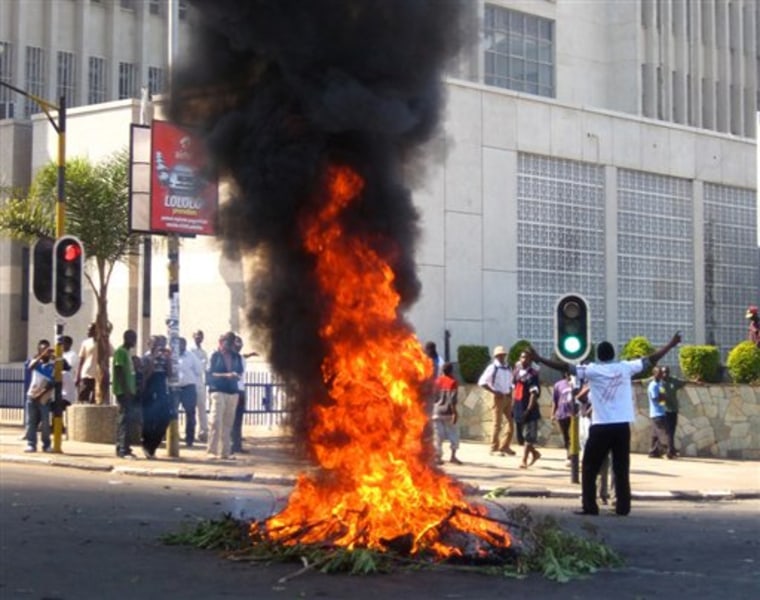
It is also a rare echo south of the Sahara of the popular uprisings that have engulfed north Africa and the Middle East over the last seven months.
'Autocratic'
Mutharika has presided over six years of high-paced but aid-funded growth, and the sheen came off earlier this year when he became embroiled in a diplomatic row with Britain, Malawi's biggest donor, over a leaked embassy cable that referred to him as "autocratic and intolerant of criticism".
The cable led to the expulsion of Britain's ambassador to Lilongwe, and in response, Britain expelled Malawi's representative in London and suspended aid worth $550 million over the next four years.
The freeze has left a yawning hole in the budget of a country that has relied on handouts for 40 percent of its revenues, and intensified a foreign currency shortage that is threatening the kwacha's peg at 150 to the dollar.
The dollar crunch has also pushed up fuel prices and exacerbated an already chronic energy shortage, making a government economic growth forecast of 6.6 percent for this year look increasingly unrealistic.
As the unrest erupted on Wednesday, state media broadcast a long economics lecture by Mutharika in which he harangued critics, including the International Monetary Fund (IMF).
Ordinary Malawians say they are fed up with hearing that foreigners are to blame for all the country's woes.
"The demonstrations have sent a message to the president that he's too detached from reality and has to act fast," said Fainess Mandewe, as she queued for fuel at a filling station on the outskirts of Blantyre.
"We need fuel, we need electricity. Blaming donors won't help in any way."
