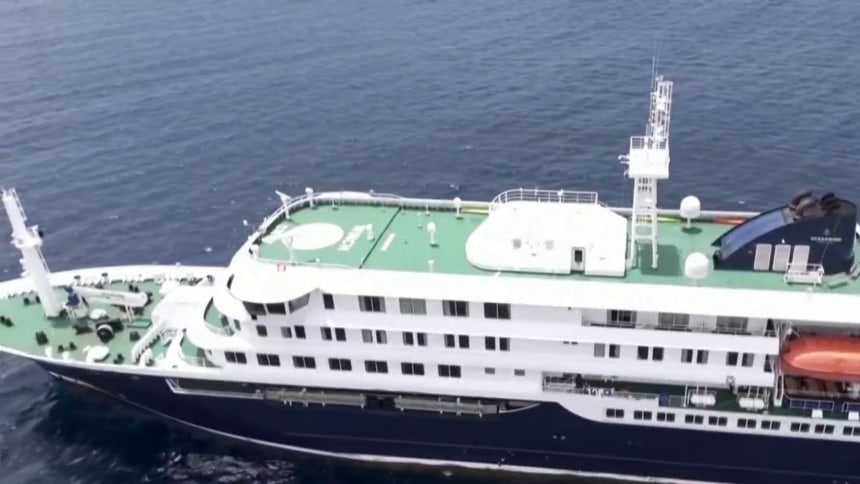
Seventeen American passengers aboard the cruise ship at the center of a hantavirus outbreak will quarantine at a Nebraska facility that specializes in handling patients with highly communicable diseases, health officials said.
The MV Hondius is expected to arrive in Tenerife in Spain’s Canary Islands on Sunday.
A team from the Centers for Disease Control and Prevention will meet the American passengers there, an agency official confirmed to NBC News. And the State Department is arranging a repatriation flight back to the U.S. for them, a department spokesperson said Friday.
The 17 passengers will be received at the National Quarantine Unit, a secured facility on the University of Nebraska Medical Center campus in Omaha, said Dr. Michael Wadman, the unit’s medical director.
There, teams will assess them and determine any necessary quarantine measures, he told reporters Friday. They will also be monitored daily.
All of the people being transported to Nebraska are in good health and are asymptomatic, but should anyone be diagnosed with the virus, they would would be moved to the Nebraska Biocontainment Unit, said Dr. Angela Hewlett, the medical director of that unit.
The Biocontainment Unit treats patients with hazardous communicable diseases in sterile environments that maximize safety and containment. It features an isolation unit, a HEPA filtration system and specialized sterilization “autoclaves” with double doors to decontaminate waste and linens.
Hewlett emphasized that the current outbreak is not at Covid levels.
“I do not see this as progressing to a worldwide pandemic, although there’s still a lot of unknowns, and I think we all need to recognize that,” she said.

Six confirmed cases
Six cases of the Andes hantavirus have been confirmed and two cases are probable, the World Health Organization said Friday.
Two people with confirmed cases and one person with a probable case have died, it said, as countries around the world seek to trace and monitor passengers who left the Hondius at points along its voyage.
Cruise operator Oceanwide Expeditions said Friday that none of the passengers who remain aboard the Hondius have tested positive for hantavirus or are showing symptoms.

Flight passenger being treated
Spanish officials said a woman from Alicante who was on the same flight as a passenger who later died of hantavirus is being treated at a hospital for a suspected infection.
The Spanish Health Ministry said in a Friday briefing that a 32-year-old woman was being treated in her home city after the regional Valencian health authority contacted her through a Europe-wide health alert system.
The woman was “sitting two rows behind the person who died from hantavirus, a person who tested positive, having had only brief contact as they were on board the plane for a short time,” Secretary of State for Health Javier Padilla told a news conference.
On Saturday the woman’s PCR test came back negative for hantavirus, Spanish Minister of Health Mónica Garcia said. A second diagnostic test will be carried out after 24 hours, she said.
The unidentified Dutch woman who later died — whose husband died at sea aboard the Hondius — was removed from a flight from Johannesburg to Amsterdam because staff were so concerned about her condition.
On Friday, the WHO confirmed that a flight attendant, who was not on the ship, was negative for the virus following testing at a hospital in the Netherlands.
A German national has also died in the outbreak.
Suspected case on Atlantic island
On Friday, British authorities confirmed a new suspected case on the tiny Atlantic island of Tristan da Cunha, one of the most remote inhabited places on Earth, with about 220 permanent residents, where the Hondius made its first scheduled stop on April 15.
Stephen Doughty, the U.K. minister for overseas territories, wrote in a letter to the Tristan da Cunha administration that the patient was “an islander” and that their spouse was isolating.
Doughty added that four islanders hitched a lift with the Hondius to nearby St. Helena.
The U.K. Health Security Agency confirmed that this patient was on board the Hondius and added that two additional British nationals have now been confirmed to have the virus, which is typically contracted through contact with rodents. Person-to-person transmission is rare, though officials say it is possible through close personal contact.

Disembarkation plans
The Hondius is making its way from Cape Verde, in western Africa, to the Canary Islands ahead of its planned docking at Tenerife, when the WHO, alongside Dutch, British and Spanish officials, will also collaborate in the evacuation and testing of the remaining passengers.
The Spanish Health Ministry released its protocol plan on Friday for those disembarking from the Hondius. The plan will require passengers and staff who were aboard the ship between April 1 and May 10 — or who had close contact with a confirmed case — to quarantine at a Madrid military hospital under active monitoring.
“Passengers will remain in single rooms without visitors,” the health ministry said in a news release. “During this period, they will undergo a PCR test upon arrival and another seven days later. Active surveillance will also be conducted, including twice-daily temperature checks to detect any compatible symptoms early.”
If a patient develops a fever, shortness of breath or other relevant symptoms, they will be transferred to a negative-pressure isolation room, the health ministry said. If they test positive, the patient “will be admitted to a High-Level Isolation and Treatment Unit (UATAN) until clinical recovery.”
The U.K. health agency said all British passengers will be asked to isolate for 45 days upon returning to the U.K., noting that the disease’s incubation period can be up to six weeks.
The U.S. State Department — which is arranging flights for the Americans in coordination with the CDC, the U.S. Department of Health and Human Services and the Spanish government — is prepared to provide consular assistance as soon as the ship arrives in Tenerife, a spokesperson said.
The spokesperson added that the State Department is in “direct communication” with Americans aboard the ship.
In Tenerife, some residents are anxious about the disembarkation and what it would mean for the island and its tourism industry if hantavirus were to spread there.
The WHO and health officials in numerous countries have stressed that the risk of the outbreak spreading to wider populations is low and that hantavirus is only transmitted through close personal contact, unlike airborne diseases such as Covid-19.

Global investigation
A WHO investigation is underway to identify the source of the hantavirus outbreak, which is rare but endemic in parts of Argentina where the Hondius began its voyage.
The WHO said Friday that the “working hypothesis” is that the first case — the man who died on the ship 10 days after boarding on April 1 — was infected at some point during his activities in Argentina and Chile.
The man had spent three months traveling through Argentina, Chile and Uruguay before boarding, the WHO said. His is considered a probable case, the WHO said.
Oceanwide Expeditions said Friday that the mood on board the vessel remained calm, with guests and crew following procedures and under the guidance of a medical team.
Khabir Moraes, a chef working on the Hondius, praised the medical response in an Instagram post. He assured his followers that he is “fit, fine, and doing well” and said there were no additional hantavirus cases.
“The situation on board is being managed with the utmost care,” he wrote in the post. “We are in excellent hands, with three additional doctors now on board to assist us, including a representative from the World Health Organization.”
The cruise operator said Friday that one of the people evacuated from the ship, who had shown potential signs of hantavirus, was the ship’s doctor.
At least seven Americans who were on the vessel are isolating at home across five states, and none show any symptoms of the virus, according to local health officials.