
On Monday, President Obama signed a historic free trade deal with several Asia and Pacific countries to spur trade and growth. Here's 6 things you need to know to be able to make a few intelligent remarks about it at the office coffee machine.
What does the deal do?
The Trans-Pacific Partnership (TPP) seeks to create a free trade zone between the U.S. and Canada and 10 main countries in the Pacific. Signing members want to make it easier and safer to buy and sell overseas and open up new markets to U.S. companies.
How does it do that?
The agreement lowers taxes on foreign goods to encourage more imports and exports. It also sets up various regulations to protect businesses and consumers - like an open Internet, rules against counterfeiting and intellectual property theft, and environmental protections.
Overall, the members believe the deal will stimulate economic growth among all the signing countries, and also work to check China's economic might.
What countries are involved?
The deal is between the United States and 11 other countries: Australia, Brunei, Canada, Chile, Japan, Malaysia, Mexico, New Zealand, Peru, Singapore, and Vietnam.
Trans Pacific Partnership: Meet the Players










Will it really create jobs?
According to research by the Peterson Institute, the deal will increase U.S. exports by $123 billion. Using back of the envelope math, the White House has estimated an increase of 650,000 jobs. However, the same think tank's research estimated some job losses as people leave one sector to work in another. Meanwhile, critics say it will create jobs -- overseas. They worry U.S. businesses will exploit lower wage workers in foreign countries and cut jobs stateside.
Is everyone cool with it?
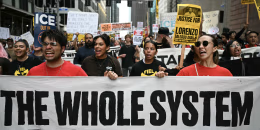
Critics and activists charge that the plan is a "giveaway" to corporations, while Sen. Orrin Hatch says it doesn't go far enough to protect trade secrets for drug manufacturers. Democrats and labor groups are concerned that the agreement will hurt jobs and the environment. But supporters, which include Obama, Republicans, and large corporations like Apple and Pfizer, say the deal simplifies the regulatory framework, enacts meaningful protections, and boosts economic gains.
Does it go into effect tomorrow?
No. At the earliest Congress might be able to vote on it in early 2016. But it could be delayed by Congressional in-fighting or by the other countries who signed the deal.

